The French press originated in France around 1850. It consists of a heat-resistant glass carafe and a metal filter with a plunger rod. It is simple to operate and preserves the complete flavor of a cup of coffee. Its immersion extraction is the closest to cupping output, fully bringing out the oils, aromas, and sweetness in coffee, making it more suitable for single-origin or flavor-forward coffee beans. This article revolves around the structure, extraction methods, and bean selection approach of the French press and the moka pot.

Qianjie Coffee's stores focus on pour-over single-origin coffee. There are over 50 kinds of single-origin coffee beans from different regions alone. How to use pour-over equipment to present the most perfect flavor of these beans is also a question Qianjie Coffee needs to consider. After comparison through Qianjie's brewing experiments, a simple pour-over method was chosen for brewing.

Of course, there are many devices that can brew coffee beans, and it is not limited to the pour-over method mentioned by Qianjie. There are also other coffee brewing devices on the market, such as the moka pot, French press, and so on. In this article, Qianjie will introduce these two coffee brewing devices to everyone.
French Press
The French press, called French Press in English, can also be called a French-style press filter pot in Chinese. The French press originated in France around 1850. It is a simple brewing device composed of a heat-resistant glass carafe and a metal filter with a plunger rod.

The French press and moka pot are also called "lazy person's coffee devices." They are simple and convenient to operate and can retain the complete flavor of a good cup of coffee. In fact, extraction with a French press is the brewing method closest to cupping output. It can fully bring out various flavor elements in coffee such as oils, aroma, and essences. The smooth, sweet, and rich taste makes it a very good choice of coffee device.
How to Make Coffee with a French Press
Step 1: First, select beans.
Because it uses immersion extraction, the French press is more suitable for single-origin or flavor-forward coffee beans. Using Qianjie Little Tomato, Qianjie Xizhua, and Qianjie Blackberry can produce an obvious juicy feel; the refreshing and pleasant taste is especially suitable for summer.

If you want a fermented feel or the characteristics of fruit wine, buy Qianjie Strawberry Candy and Qianjie Blackberry. French press coffee after immersion can deliver a full-bodied mouthfeel.

Step 2: Determine the grind size and coffee powder ratio for French press coffee beans.
The coffee grounds need to be at least about 20g. The coffee grounds should be slightly coarse (because hot water directly contacts the coffee grounds, and if too fine, over-extraction is easy). Medium grinding can be used, about 5-6 degrees. If the powder is too fine, coffee grounds will escape from the holes in the filter, and the coffee will become cloudy. You can also follow Qianjie Coffee's grind setting:
Qianjie coffee grind size standard sieve pass rate: ice drip > pour-over siphon 80% > moka American drip 75-80% > cupping 70-75% > French press 65-70%.

You can start by trying a coffee-to-water ratio of 1:10. For two servings, for example, that is 20g of coffee beans with about 200g of water. The final ratio depends on your taste. The resting time is about 3-4 minutes. The longer the immersion time, the stronger the taste and the heavier the acidity. The taste of each coffee bean and personal preference are different, so you need to try them one by one. During the resting period, do not press down the filter; let the coffee and water have more time and space to contact.
Step 3: Start making coffee with the French press
1. First grind the coffee beans, then pour them into the French press. At this point, ignore what many people say about grind size; do not grind too coarse, medium grinding is enough.

2. Boil the water. The recommended water temperature is 93°C, then pour in the appropriate amount of water. We used 20g of coffee grounds and poured in 200g of hot water. Stir with a spoon so the coffee grounds and water fully combine.

3. Put the lid on the French press with the filter resting at the highest position, then let it sit for 4 minutes.

4. Before pressing down the filter, you can open the lid and use a spoon to scoop out the foam and small fragments floating on top, then press the filter all the way down.
5. When brewing is complete, immediately pour it out into another insulated container! Do not delay, because the coffee grounds are still steeping in it. Then pour it into a cup and enjoy slowly.

Issues to Note When Using a French Press
In addition, you can also prepare an electronic scale. But even with a French press that has markings and a measuring spoon, it is still recommended to prepare an electronic scale, because coffee beans will change density due to many factors such as growing altitude and roasting method, and the mass and weight of each type of bean are different. Also, if you make a very delicious cup of coffee and want to reproduce that flavor, you must record the ratio. Conversely, if you make a bad cup of coffee, based on the data you will also know how to adjust.
Use fresh, clean soft water. Do not extract with water that is too hard, and do not use unfiltered water. If the water itself is not good, it is difficult to make delicious coffee. The French press is elegant and gentle, so pressing must be slow. If at this critical moment you violently stir the coffee, that is equivalent to speeding up the extraction process at the last moment, and at that point your coffee has already released all the good things; what is summoned next is bitterness.

If you also want to upgrade it to a milk coffee, the French press can do that too. Prepare a clean French press, pour in 1/3 warm milk, slowly insert the filter, and push and pull repeatedly until the milk is frothed to twice its original volume. At this point the milk is fully frothed and silky. Add it to the coffee and you're done.
Moka Pot
According to Qianjie's understanding, the moka pot is spelled Moka pot in English. The most common explanation is that mocha dates back to the 17th century when the first batch of coffee entered Venice. It can be said that in northern Italy, mocha is equivalent to coffee. Therefore, the moka pot is actually also called a coffee pot, meaning a brewing device that allows you to get a rich cup of coffee at home.

The moka pot is divided into three parts: the upper chamber, the filter basket, and the lower chamber. The lower chamber is the water reservoir, the filter basket is used to hold finely ground coffee, and the upper chamber holds the extracted coffee liquid. The principle of moka pot extraction is very simple: it uses the steam pressure generated in the lower chamber. When the steam pressure is strong enough to penetrate the coffee grounds, it pushes hot water up into the upper chamber, brewing rich aromatic coffee.
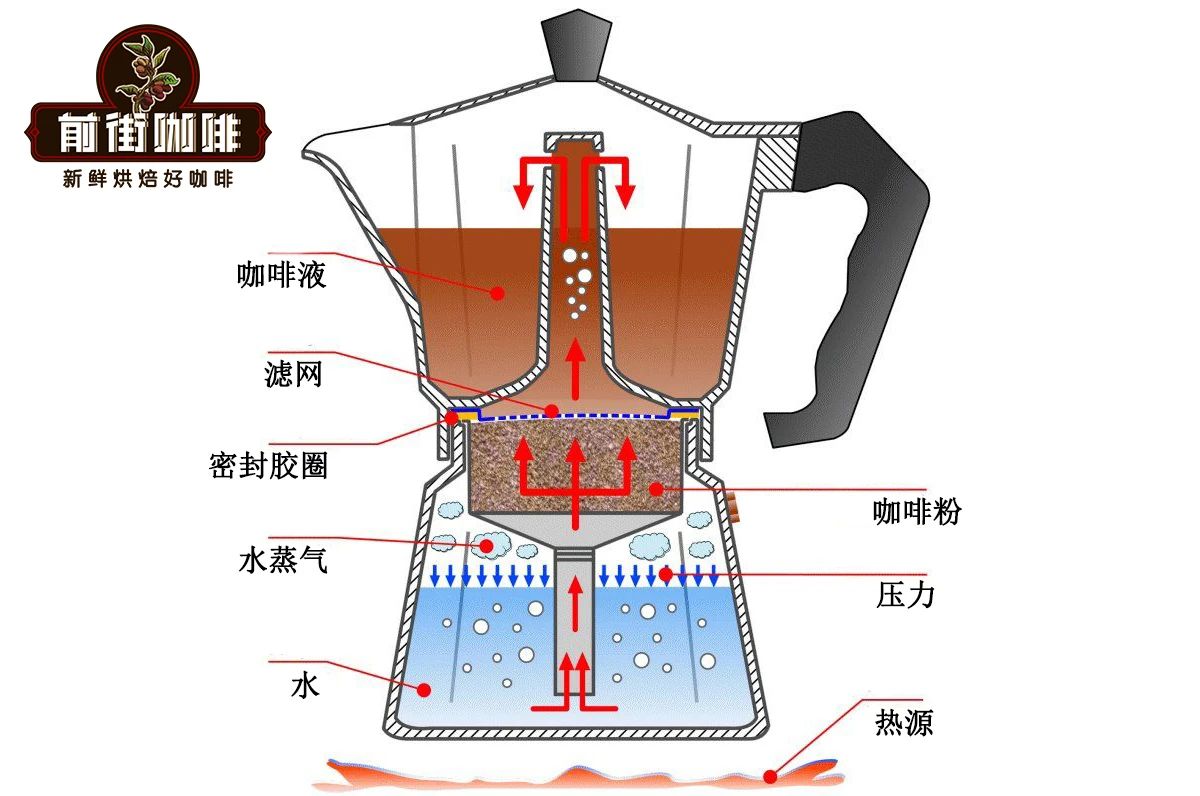
There are two conditions for moka pot coffee to have crema: one is fresh medium-to-dark roasted coffee beans, and the other is that the extraction method must use pressure. Coffee beans store a large amount of carbon dioxide during the heating process, which is released when they meet water during extraction. Therefore, the darker the roast, the more gas there is. At this time, light-roast beans should be avoided first because they cannot release much crema. For home beginners who want better value for money, prioritize buying Qianjie espresso bean series, including Qianjie Black Cocoa Blend, Qianjie Classic Blend, Qianjie Commercial Blend, and Qianjie Specialty Blend. They all use medium-dark roasting and naturally carry caramelized aroma, and the strong coffee made from them is rich in crema.

The Brewing Process of the Moka Pot
Coffee brewed in a moka pot is relatively strong, so Qianjie recommends choosing coffee beans with a darker roast to better reflect that mellow body of the coffee. The beans used by Qianjie come from coffee beans from Brazil's Queen Farm.

1. Pour purified water into the lower chamber of the moka pot. The water level should be about 0.5 cm below the pressure relief valve.

2. Choose a grind size slightly coarser than espresso. You can refer to the size of the gaps in the filter basket mesh to ensure coffee particles do not fall into the lower chamber. Slowly pour the coffee grounds into the filter basket and tap gently to distribute them evenly. When the coffee grounds form a small mound, level the coffee surface by distributing the grounds.

3. Place the filter basket into the lower chamber, tighten the upper and lower parts of the moka pot, and place it on an electric ceramic stove over high heat;

4. When the moka pot heats up to a certain temperature and makes a clear "woo woo" sound, set the electric ceramic stove to low heat and open the lid of the upper chamber.

5. When half of the coffee liquid has come out into the upper chamber, turn off the electric ceramic stove. The residual heat and pressure of the moka pot will "push" the remaining coffee liquid into the upper chamber.

6. When all the coffee liquid has been extracted into the upper chamber, it can be poured into a cup and tasted. Coffee extracted with a moka pot is very rich and can even extract Crema. It can also be mixed with an appropriate amount of water or milk for a better flavor.

Light Roast Pour-Over Floral Coffee Beans Recommendation: Qianjie Yirgacheffe Gedeo Dingding, Qianjie Panama Hacienda La Esmeralda Green Label Geisha Coffee Beans, QianjiePanama Butterfly Coffee Beans
Daily medium-light roast Yirgacheffe pour-over floral coffee bean recommendation, Qianjie Yirgacheffe Guddina, light roast brings the signature white floral notesAromatic, with lemon-citrus fruit notes and a refreshing floral tea note; bright and crisp on the palate. Great value and an ideal entry-level pour-over coffee with floral and fruity notesAn unrivalled choice.
Moka pot, home espresso, and espresso-based milk drinks like latte — recommended beans: Qianjie Classic Espresso Blend, using BrazilianWest, with Mandheling Arabica and a small amount of Vietnamese Robusta fully blended, delivering a rich and outstanding espressocrema; overall style is rich and memorable. Qianjie Brazil Queen's Estate coffee beans and Qianjie Classic Espresso Blend coffee beans are both mochaA highly recommended option for pot-style espresso machines.
Fruity-floral signature espresso latte bean recommendation: Qianjie Strawberry Candy espresso blend, featuring strawberry gummy and rose aromas,Full-bodied sweetness with a grape and almond finish; especially stunning as an iced latte. Made from Costa Rican honey-process beans, PanamaBlended from Panama Geisha coffee beans and select beans from Colombia's Huila region. Not only does it overturn traditional espresso flavor, the cremaalso performs well, with impressive showings in creative specialty drinks.
Now available on Taobao store「 Qianjie Coffee 」To purchase the above coffee beans, Qianjie Coffee offers dozens of selected single-origin pour-over and espresso coffee beans from around the world. Qianjie CoffeeQianjie Coffee is a veteran specialty coffee roaster; beans are freshly roasted within 5 days, with consistent quality and highly competitive pricesGreat value, ships within 24 hours. Qianjie Coffee is recommended by many coffee lovers and platforms.
Taobao Qianjie Coffee Link: https://qianjiecoffee.taobao.com
Or search our shop directly on Taobao 「Qianjie Coffee」
Qianjie Coffee Store Address: 315 Donghuadong Road, Yuexiu District, Guangzhou

Site Recommendations: 耶加雪菲 花魁咖啡 瑰夏咖啡 波旁咖啡 蓝山咖啡 天堂鸟咖啡豆 曼特宁咖啡豆 PWN黄金曼特宁 星巴克菜单 咖啡豆种类
Please indicate the source when reprinting.
2026-08-09 14:23:02
