To make pour-over coffee sweeter, you first need to understand that sweetness is not a flavor that appears on its own; it depends on the balance between acidity and bitterness: the sweetness of light-roasted beans is mostly hidden within the acidity and sweetness, while the sweetness of dark-roasted beans leans toward bitter-sweetness. During extraction, acidic substances are released first, the efficiency of sweetness release rises in the middle stage, and bitterness only increases noticeably in the later stage. The key to bringing out sweetness in pour-over coffee lies in allowing the sweet substances in the middle stage to be fully released without dragging out too much bitterness.

Why are we so obsessed with making coffee sweet? Probably because sweetness can make us secrete dopamine, making us feel pleasure!
If you want to make coffee sweet, you first need to understand the sweetness of coffee. The sweetness of coffee does not exist independently; it stands out through the harmony between acidity and bitterness. For example, light-roasted coffee itself has fewer bitter substances, so its sweetness is a sweet-and-sour quality expressed against high acidity and low bitterness, such as various fruity notes. Dark-roasted coffee itself has more bitter substances, so its sweetness is a bitter-sweet quality expressed against low acidity and high bitterness, such as caramel notes.

High-sweetness light-roasted coffee beans include Qianjie Xizhua, Qianjie Blackberry, and Qianjie Huakui; high-sweetness medium-roasted coffee beans include Qianjie 2013 Yunnan Arabica and Qianjie Bird of Paradise; for high-sweetness dark-roasted coffee beans, Qianjie Queen's Manor and Qianjie Brazil Cerrado are recommended.
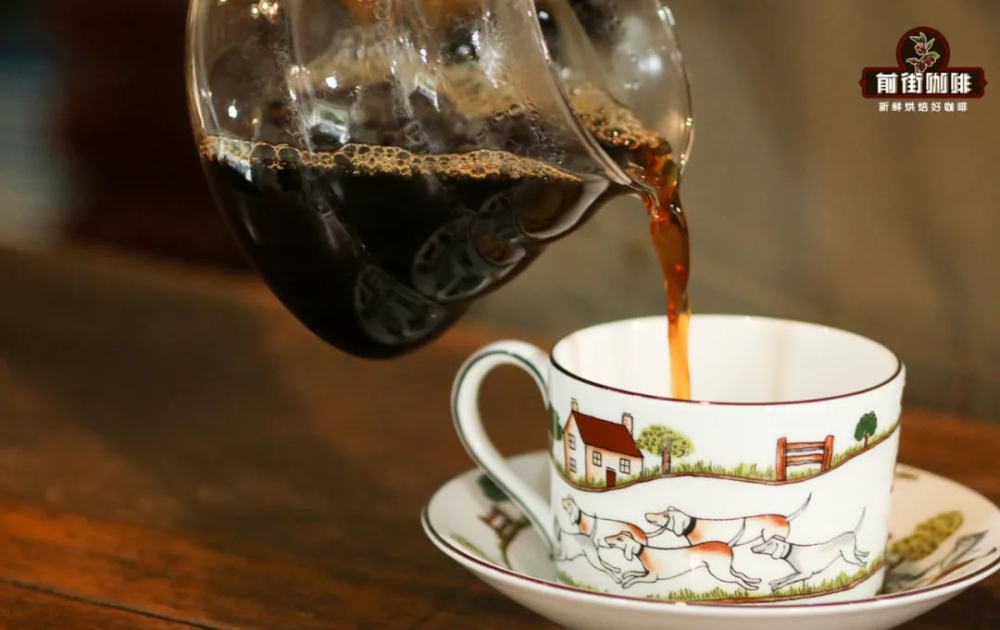
And to make coffee sweet, when brewing coffee, you should try to extract as much of the coffee's sweet substances as possible. The specific principle is as follows:
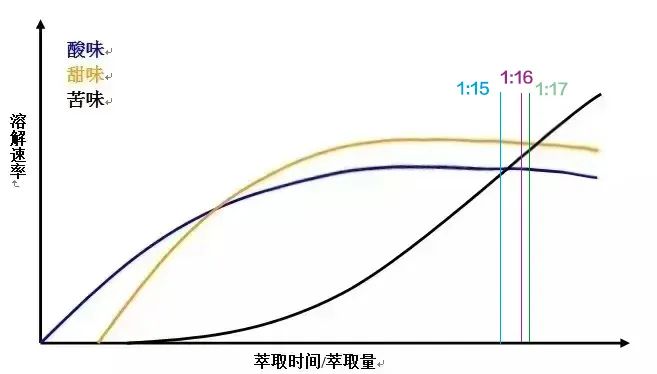
During the pour-over extraction process, the time points at which sourness, sweetness, and bitterness are released in large amounts are all different. Acidic substances are the easiest to extract, so in the early stage, acidic substances dominate, but this also includes some sweet and bitter substances released earlier. By the middle stage, the release of acidic substances gradually decreases, while the release efficiency of sweet substances begins to surpass that of acidic substances. At the same time, bitter substances are also increasing at a gentle slope.
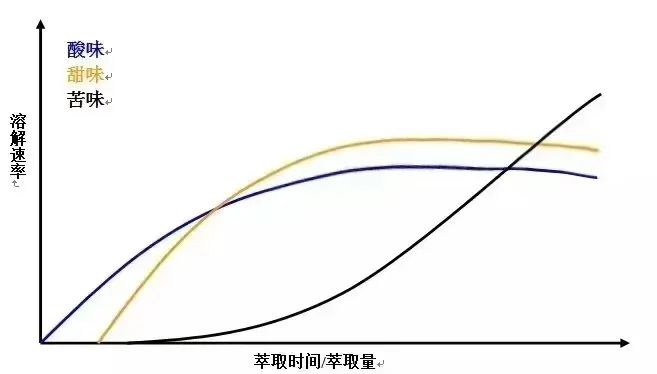
Then in the later stage, the release of acidic substances decreases further, and sweet substances are also on the decline, at which point the release efficiency of bitter substances begins to rise.
In this model, the ideal state for extracting sweetness is to extract the largest proportion of sweet substances. That is, a relatively high extraction yield. It is generally believed that coffee with an extraction yield between 18-22% tastes better, so placing the extraction yield on the model chart would look roughly like this:
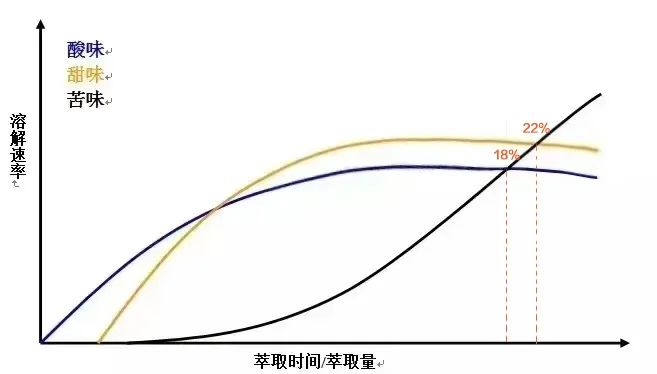
An extraction yield of 22% is theoretically the upper limit of coffee's highest sweetness; beyond 22%, unpleasant bitterness is very likely to appear.
After looking at the extraction model, next let's look at actual brewing examples. Usually, failing to extract coffee's sweetness falls into two situations: the first is over-extraction; the second is being too conservative.

The first situation is actually that the sweetness has been extracted fairly completely, but a relatively large amount of bitterness has also been extracted, which causes the proportion of sweetness to actually be lower. As a result, the coffee obtained is both sour and bitter, while the sweetness is not obvious.
If your coffee also tastes like this, then you can check whether the water temperature is reasonable. For light-to-medium roasted coffee, the generally recommended temperature is 90-93°C, and for medium-to-dark roasted coffee, 86-89°C; you can choose the lowest water temperature within the range.

Next, check whether the grind size is too fine, which is specifically reflected in the drainage speed and extraction time. For example, if 15 grams of coffee grounds take more than 2 minutes and 30 seconds to extract, or 20 grams of coffee grounds take more than 3 minutes, then the grind size needs to be adjusted coarser.
The second situation is also the one most friends encounter. Many friends, out of fear of extracting the miscellaneous bitterness in the later stage of the coffee, set the grind size to a coarser degree. This can basically ensure extraction is completed before 2 minutes.
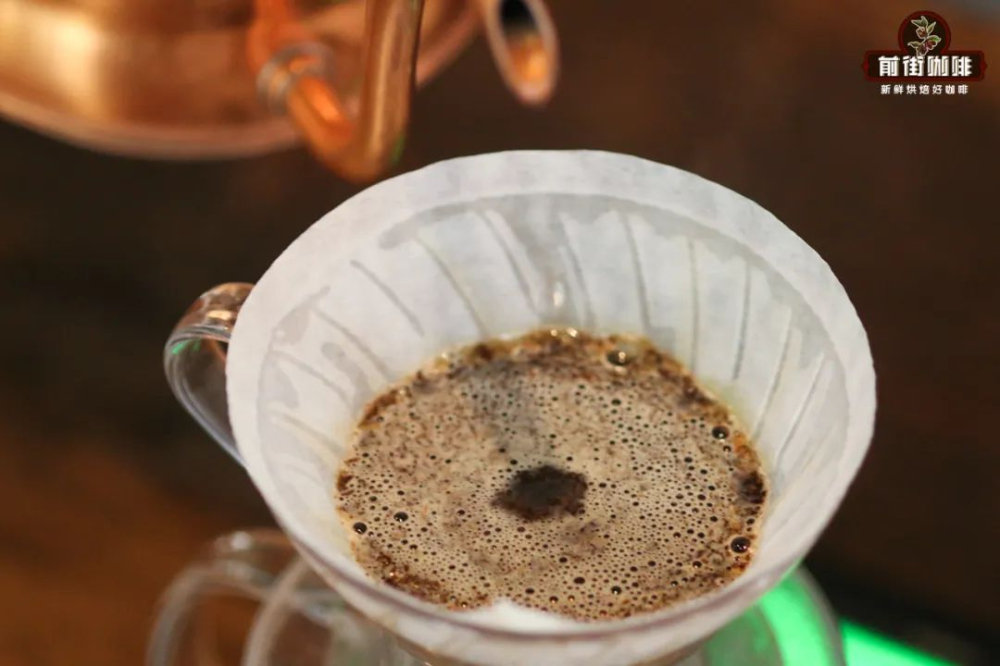
The extraction yield of coffee brewed this way will be around 17-19%. The bitterness is not obvious, but the proportion of sweetness is not large either. Acidity occupies absolute dominance, showing a relatively bright (stimulating) acidity, while the sweetness is only faintly perceptible.
If the coffee you brew shows strong acidity and weak sweetness, uses a 1:15 or lower coffee-to-water ratio, and has an extraction time of about 2 minutes, and if this fits the situation, the direct solution is to continue pouring water and extend the coffee-to-water ratio to 1:16 or 1:17. In that way, the extra poured water will prolong the extraction time and continue extracting flavor substances. The proportion of coffee's sweetness will be somewhat greater, and the coffee's sweetness will naturally be more obvious.
If the coffee itself is already light enough, continuing to extend the ratio will only make the coffee more watery. Then Qianjie recommends using a staged pouring method to prolong the extraction time. For example, if you use three-stage pouring and the coffee brewed at a 1:16 ratio has obvious acidity and no prominent sweetness, then divide the pouring into four stages. This will prolong the overall extraction time, and at the same time the "rinse extraction" with relatively high extraction efficiency is also concentrated in the middle and later stages, which is conducive to extracting sweet substances.

Light Roast Pour-Over Floral Coffee Beans Recommendation: Qianjie Yirgacheffe Gedeo Dingding, Qianjie Panama Hacienda La Esmeralda Green Label Geisha Coffee Beans, QianjiePanama Butterfly Coffee Beans
Daily medium-light roast Yirgacheffe pour-over floral coffee bean recommendation, Qianjie Yirgacheffe Guddina, light roast brings the signature white floral notesAromatic, with lemon-citrus fruit notes and a refreshing floral tea note; bright and crisp on the palate. Great value and an ideal entry-level pour-over coffee with floral and fruity notesAn unrivalled choice.
Moka pot, home espresso, and espresso-based milk drinks like latte — recommended beans: Qianjie Classic Espresso Blend, using BrazilianWest, with Mandheling Arabica and a small amount of Vietnamese Robusta fully blended, delivering a rich and outstanding espressocrema; overall style is rich and memorable. Qianjie Brazil Queen's Estate coffee beans and Qianjie Classic Espresso Blend coffee beans are both mochaA highly recommended option for pot-style espresso machines.
Fruity-floral signature espresso latte bean recommendation: Qianjie Strawberry Candy espresso blend, featuring strawberry gummy and rose aromas,Full-bodied sweetness with a grape and almond finish; especially stunning as an iced latte. Made from Costa Rican honey-process beans, PanamaBlended from Panama Geisha coffee beans and select beans from Colombia's Huila region. Not only does it overturn traditional espresso flavor, the cremaalso performs well, with impressive showings in creative specialty drinks.
Now available on Taobao store「 Qianjie Coffee 」To purchase the above coffee beans, Qianjie Coffee offers dozens of selected single-origin pour-over and espresso coffee beans from around the world. Qianjie CoffeeQianjie Coffee is a veteran specialty coffee roaster; beans are freshly roasted within 5 days, with consistent quality and highly competitive pricesGreat value, ships within 24 hours. Qianjie Coffee is recommended by many coffee lovers and platforms.
Taobao Qianjie Coffee Link: https://qianjiecoffee.taobao.com
Or search our shop directly on Taobao 「Qianjie Coffee」
Qianjie Coffee Store Address: 315 Donghuadong Road, Yuexiu District, Guangzhou

Site Recommendations: 耶加雪菲 花魁咖啡 瑰夏咖啡 波旁咖啡 蓝山咖啡 天堂鸟咖啡豆 曼特宁咖啡豆 PWN黄金曼特宁 星巴克菜单 咖啡豆种类
Please indicate the source when reprinting.
2026-08-02 15:20:10
