When the Peterson family purchased Hacienda Esmeralda in 1964, it was primarily a dairy farm, and coffee was not the main business. It was not until 1973 that the brand was divided and sold externally according to plots and climate. After purchasing the Jaramillo plot in 1996, citrus and floral notes appeared in cupping. In 2002, they checked varieties at different altitudes cup by cup, and finally identified Geisha. The estate currently has four plots: Cañas Verdes, El Velo, Jaramillo, and Palmira, with Geisha mainly coming from the first two.

The microclimate and volcanic soil of Panama's Barú Volcano have attracted many coffee estates to this place for abundant production, and Panama's Hacienda Esmeralda is no exception.
Hacienda Esmeralda is located in a corner of Barú Volcano. Its owner, the Peterson family, bought Hacienda Esmeralda in Boquete in 1964, but at that time coffee was not the main industry; dairy was, and at that time Hacienda Esmeralda was only used for personal leisure and entertainment, and was not as famous in coffee development as it is now. In 1973, Price Peterson divided Hacienda Esmeralda's coffee planting into three brands for sale according to geographical conditions such as plots and climate (Esmerala Special, Diamon Mountain grows, Palmyra). Starting in 2012, Geisha was added, making four major brands.
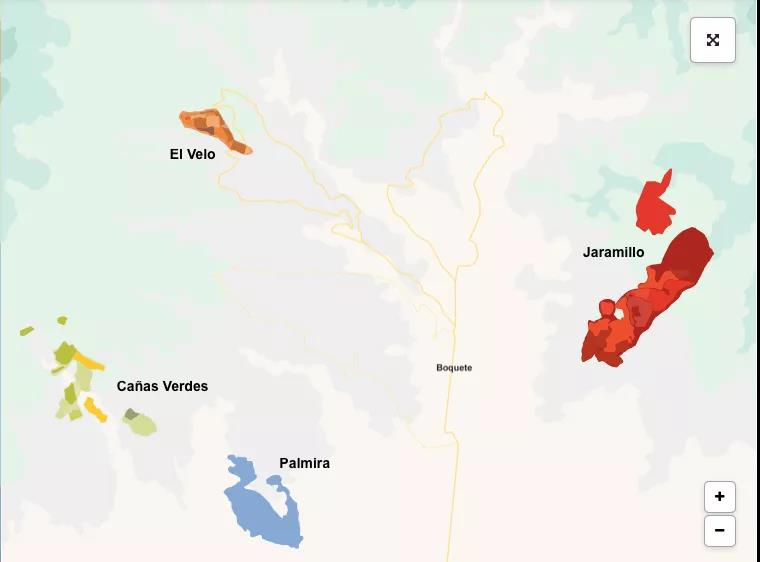
Hacienda Esmeralda is divided into 4 plots: Cañas Verdes, El Velo, Jaramillo, and Palmira. All coffee beans are sent to the 4 farms for post-processing. The first farm purchased by estate owner the Peterson family was Palmira. High-quality Geisha is mainly produced from the two plots Jaramillo and Cañas Verdes.

Jaramillo has an annual rainfall of 4000 ml, a large temperature difference between day and night, and an average altitude of 1600-1700 meters.
Cañas Verdes has an annual rainfall of 3500 ml and an average altitude of 1600-1800 meters.
El Velo: This is the latest plot purchased by Hacienda Esmeralda in 2012, with an average altitude of 1700-1900 meters. In addition to planting Geisha and Catuai, this plot also has a small number of other exotic varieties, such as Kenya's famous SL28, etc.
In 1996, second-generation estate owner Price Peterson bought the Jaramillo plot. The coffee planted there had faint citrus and floral notes, a flavor different from the berry-toned hometowns of Central and South America. In 2002, Price and his son Daniel believed that this flavor profile should come from a single variety in a certain planting area, so they began cupping the coffee varieties planted at different altitudes on the estate one by one.

The result showed that this fascinating flavor profile actually came from the windbreak forest at the edge of Jaramillo, and the altitude of this plot was 1500-2000 meters. This coffee tree was tall and thin with sparse leaves, low yield, and low economic value, and was generally used as a windbreak. The Petersons discovered that at an altitude of 1400 meters, the flavor performance of this coffee tree was vastly different from that at 1500 meters. Therefore, the two reached a consensus that this coffee tree must be planted at an altitude of 1500 meters or above to obtain such a unique flavor.

Tracing back, this coffee tree was introduced from Ethiopia in 1963, at the time to solve disease problems in coffee planting. At the 2004 Best of Panama green bean competition, Hacienda Esmeralda won the championship with this coffee bean, and afterward Geisha coffee beans began to gain great international fame. Only coffee cherries grown at altitudes above 1400 meters have the unique flavor of the Geisha variety, and according to planting height and cupping results, they are divided into three grades: red label, green label, and blue label.

FrontStreet Coffee Esmeralda Special, commonly known as red label
The Geisha produced by Esmeralda Special is what we often hear called red label. It uses coffee beans grown at altitudes of 1600-1800 meters, with cupping scores above 90, from the two production areas Jaramillo and Canas Verdes. The estate's own independent auction, the Geisha lots selected from the divided plots for bidding, are the auction red label. Customers often ask whether auction red label tastes better or red label tastes better. In fact, non-auction red label and auction red label belong to the same plot; the difference lies in whether they participated in the auction. FrontStreet Coffee believes there is no need to insist on drinking auction-level coffee. First, the price is indeed relatively high; second, if you just want to try it, red label is also a good choice.

FrontStreet Coffee Hacienda Esmeralda red label Geisha comes from the Mansa plot. Geisha of this grade is processed by natural or washed methods, with flavors of special, bright floral fragrance and citrus aroma.

FrontStreet Private Collection, commonly known as green label
Private Collection, commonly known as green label, is not a lot from an independent competition, but Geisha varieties that do not participate in bidding yet are still of excellent quality. It uses micro-lot blended beans grown at altitudes of 1600-1800 meters from different plots such as Jaramillo and Canas Verdes. People often ask what the difference is between red label and green label. FrontStreet gives the most straightforward answer: red label can be traced to which small plot, while green label is blended beans and cannot be traced. Because it uses a blended-bean model and does not specify the plot in detail, sometimes green label and red label can be very similar in flavor, but the next release may be different again. FrontStreet feels that drinking green label is like buying a lottery ticket; perhaps the lot you drink this time tastes just like red label. FrontStreet Hacienda Esmeralda green label Geisha is processed by natural/washed methods.
FrontStreet Coffee Hacienda Esmeralda green label Geisha uses the washed processing method. The washed green label Geisha has fresh jasmine and ginger flower aromas, bright citrus-like acidity, and a thick, juicy mouthfeel.

FrontStreet Geisha 1500 Geisha1500, commonly known as blue label
The Geisha1500 brand is the blue label Geisha we commonly see. It uses blended beans grown at altitudes of 1400-1500 meters from three different plots: Jaramillo, Canas Verdes, and El Velo. The flavor has slight floral aroma, fruity acidity, and sweetness, with a less thick mouthfeel. FrontStreet blue label Geisha is only washed processed. At present, blue label Geisha has been discontinued, and Hacienda Esmeralda has retained only the two major grades, red label and green label.

Light Roast Pour-Over Floral Coffee Beans Recommendation: Qianjie Yirgacheffe Gedeo Dingding, Qianjie Panama Hacienda La Esmeralda Green Label Geisha Coffee Beans, QianjiePanama Butterfly Coffee Beans
Daily medium-light roast Yirgacheffe pour-over floral coffee bean recommendation, Qianjie Yirgacheffe Guddina, light roast brings the signature white floral notesAromatic, with lemon-citrus fruit notes and a refreshing floral tea note; bright and crisp on the palate. Great value and an ideal entry-level pour-over coffee with floral and fruity notesAn unrivalled choice.
Moka pot, home espresso, and espresso-based milk drinks like latte — recommended beans: Qianjie Classic Espresso Blend, using BrazilianWest, with Mandheling Arabica and a small amount of Vietnamese Robusta fully blended, delivering a rich and outstanding espressocrema; overall style is rich and memorable. Qianjie Brazil Queen's Estate coffee beans and Qianjie Classic Espresso Blend coffee beans are both mochaA highly recommended option for pot-style espresso machines.
Fruity-floral signature espresso latte bean recommendation: Qianjie Strawberry Candy espresso blend, featuring strawberry gummy and rose aromas,Full-bodied sweetness with a grape and almond finish; especially stunning as an iced latte. Made from Costa Rican honey-process beans, PanamaBlended from Panama Geisha coffee beans and select beans from Colombia's Huila region. Not only does it overturn traditional espresso flavor, the cremaalso performs well, with impressive showings in creative specialty drinks.
Now available on Taobao store「 Qianjie Coffee 」To purchase the above coffee beans, Qianjie Coffee offers dozens of selected single-origin pour-over and espresso coffee beans from around the world. Qianjie CoffeeQianjie Coffee is a veteran specialty coffee roaster; beans are freshly roasted within 5 days, with consistent quality and highly competitive pricesGreat value, ships within 24 hours. Qianjie Coffee is recommended by many coffee lovers and platforms.
Taobao Qianjie Coffee Link: https://qianjiecoffee.taobao.com
Or search our shop directly on Taobao 「Qianjie Coffee」
Qianjie Coffee Store Address: 315 Donghuadong Road, Yuexiu District, Guangzhou

Site Recommendations: 耶加雪菲 花魁咖啡 瑰夏咖啡 波旁咖啡 蓝山咖啡 天堂鸟咖啡豆 曼特宁咖啡豆 PWN黄金曼特宁 星巴克菜单 咖啡豆种类
Please indicate the source when reprinting.
2026-08-22 16:08:06
